
Comprehensive Genetic Mapping in Cancer Treatment: Beyond Narrow Panels and the Power of Molecular Team Experience

1. Reading the Tumor's Genetic Code Correctly
In cancer treatment, reading the tumor's genetic code correctly in order to select the most suitable smart drug for the patient has become an undisputed standard. The Canada-based POWER study, published in The Journal of Molecular Diagnostics, is one of those rare and highly valuable comparative studies that demonstrate how using Comprehensive Genomic Profiling (CGP) instead of narrow gene panels changes patients' treatment success and their chances of survival.
Yet this concept of "comprehensive genetic mapping", still discussed as a new standard in the world of oncology, is not the future for our clinic but the reality of today and of the past 10 years. As a center that has examined the tumor tissue of more than 2,500 patients with Comprehensive Genomic Profiling to date, we evaluate the findings of this scientific study, and why more is possible, through our own molecular team experience.
2. The Problem Is Not Running the Test, It Is Interpreting It Correctly
The main reason why only narrow panels of 10 to 50 genes were used in oncology practice for many years, and why many centers still continue with these panels today, is not technological insufficiency; the real reason is the difficulty of interpretation created by broad panels.
Reading a few mutations on a narrow gene panel and prescribing a standard smart drug is relatively easy. But when the detailed genetic map of the tumor is drawn, an enormous amount of data emerges. Today the real challenge is not performing these advanced tests, but interpreting this complex molecular data scientifically in a way that converts it into clinical benefit.
At our clinic we have been overcoming this challenge for more than 10 years with our broad and experienced Molecular Tumor Board (MTB), which includes 6 specialist cancer geneticists.
3. What Does the POWER Study Tell Us?
The POWER study, which examined 554 patients with advanced-stage solid tumors, sets out in numbers just how large the opportunity costs are for patients when tests look at only certain genes:
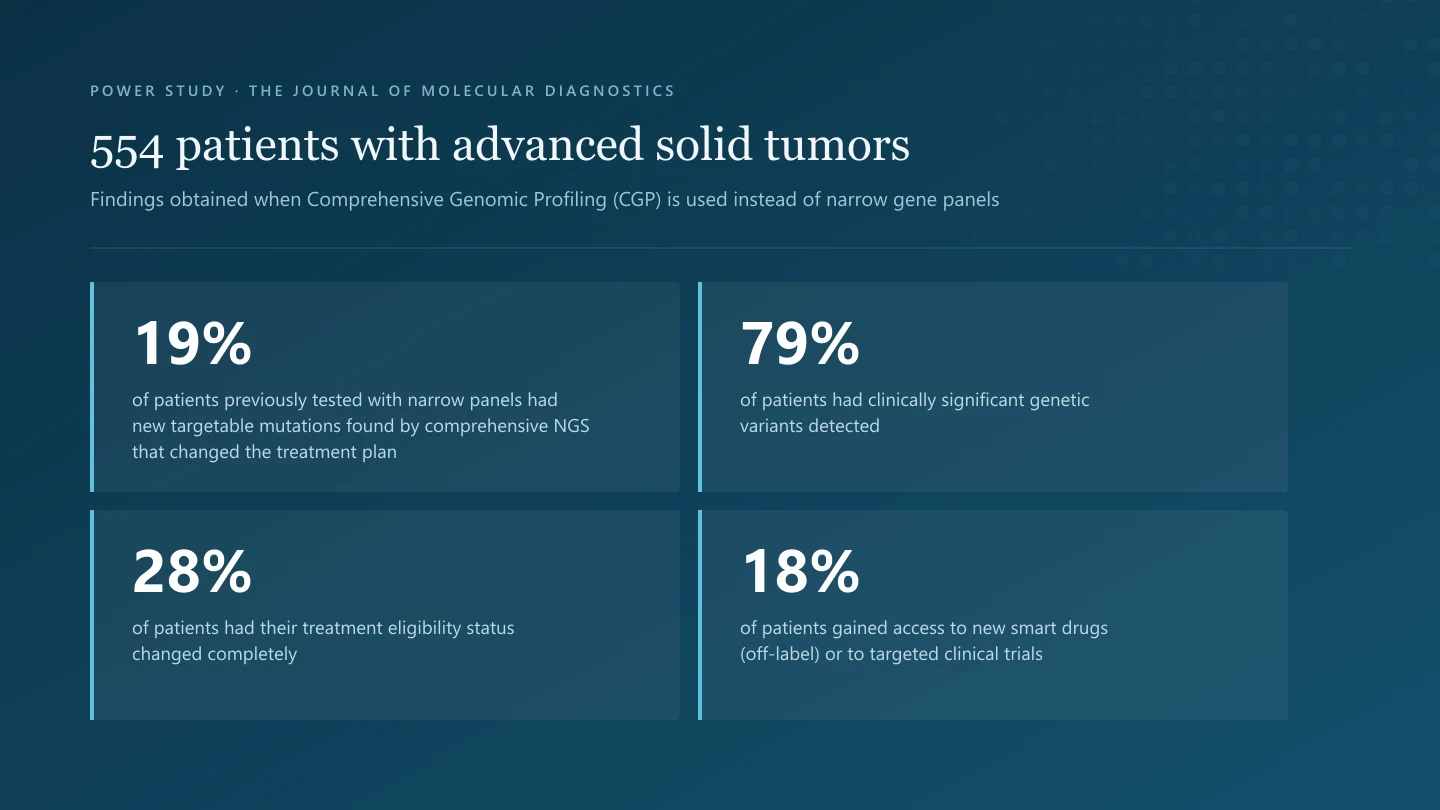
- Missed targets: In 19% of patients previously tested with standard narrow panels, comprehensive NGS (Next Generation Sequencing) revealed new targetable mutations that completely changed the treatment plan.
- Clinical meaning: Clinically significant genetic variants were detected in 79% of patients, and the treatment eligibility status of 28% changed completely.
- New treatment doors: Thanks to comprehensive genetic mapping, 18% of patients gained direct access to new smart drugs matched to their own mutations (off-label) or to targeted clinical trials.
4. Why Are 161 Genes Not Enough? Our Whole Exome and Whole Transcriptome (WES/WTS) Approach
These successful rates obtained by the POWER study were achieved with a panel of 161 genes. However, the genetic map of cancer is much larger than 161 genes.
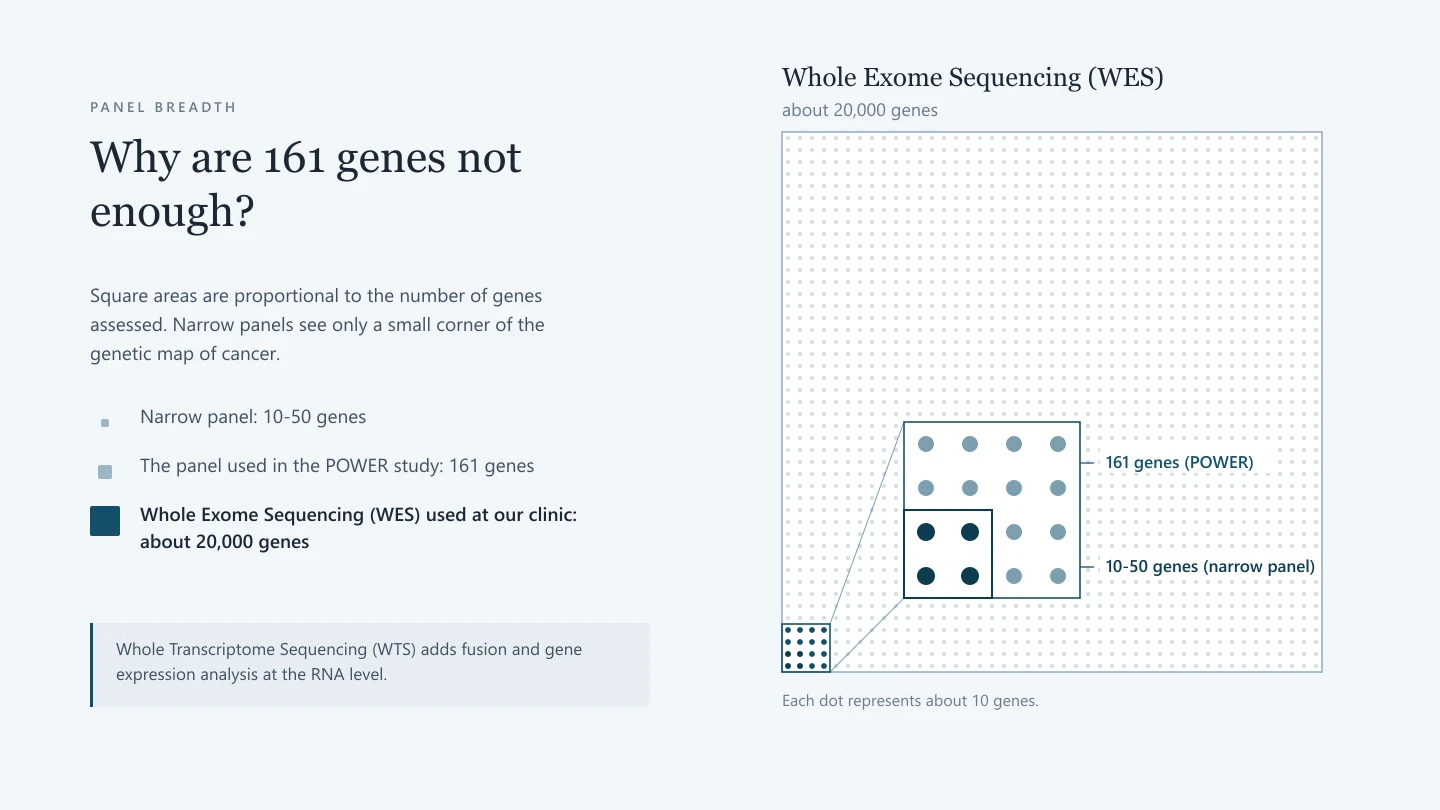
At our clinic, for our patients we use the broadest panels currently available, in which all genes where a genetic mutation may be seen are evaluated: namely Whole Exome Sequencing and Whole Transcriptome Sequencing tests.
As we have also shown clearly in our international publications, when tests are expanded to this level and interpreted scientifically and correctly by a Molecular Tumor Board largely composed of experienced cancer geneticists, it is possible to go beyond the success rates mentioned in the study.
5. Co-Occurring Mutations and Personalized Combination Therapy
One of the most striking findings of the study is that in 39% of patients more than one (co-occurring) genetic variant was present at the same time. This supports the clinical reality we emphasized in our earlier article on "Personalized Combination Therapies": cancer cells are usually fed not by a single genetic error, but by more than one mutation.
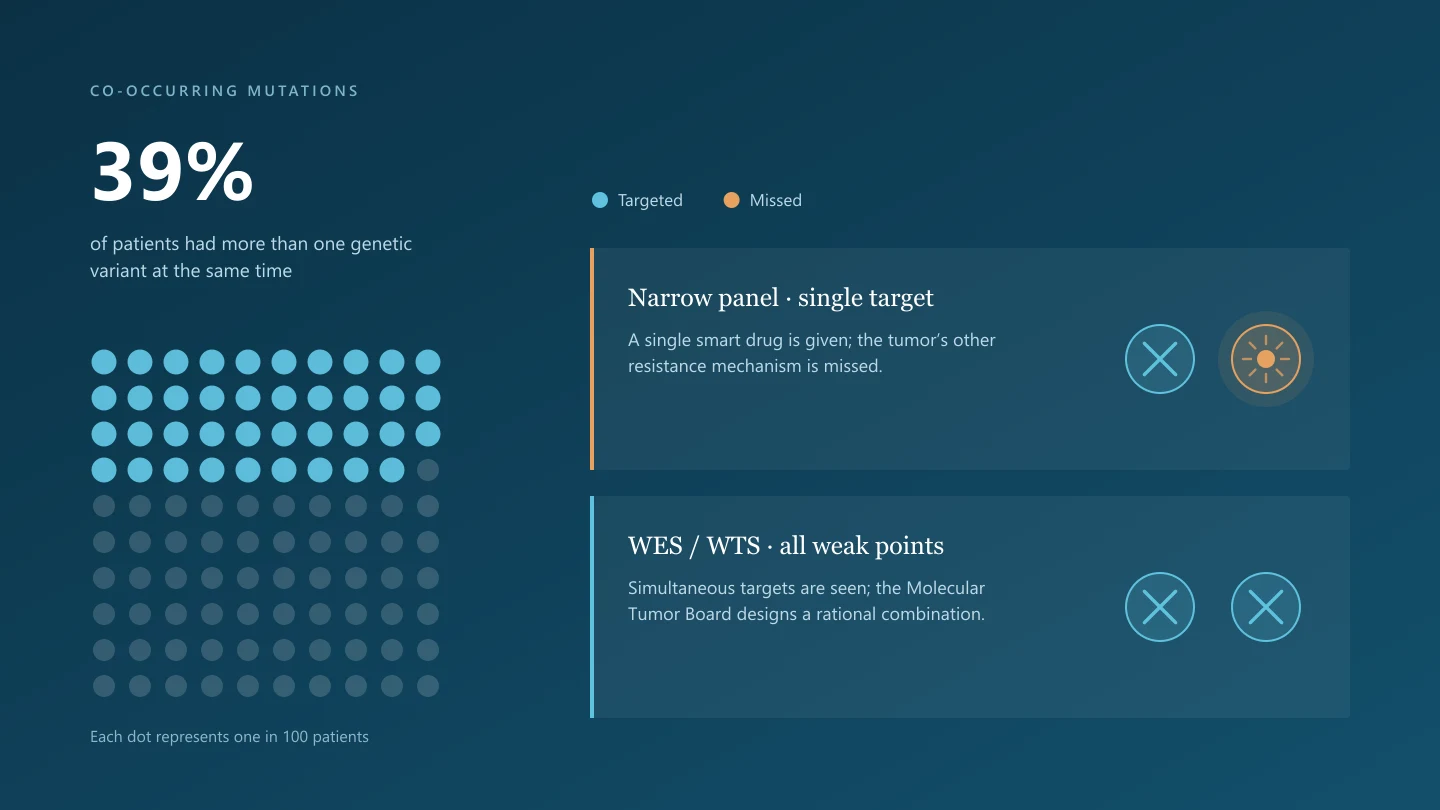
Giving a single smart drug by looking only at a narrow panel means missing the tumor's other resistance mechanisms in this 39% group of patients. The detailed genetic mapping we obtain with Whole Exome and Whole Transcriptome tests allows us to see all the weak points the tumor holds simultaneously.
In this way our Molecular Tumor Board can design rational combination therapies that are based entirely on the patient's molecular profile and on current evidence in the literature, rather than on assumption or routine.
Conclusion
Comprehensive Genomic Profiling (CGP) is a proven standard that significantly increases success rates in cancer treatment. But the real potential of this technology emerges through validated comprehensive tests (Whole Exome and Whole Transcriptome) together with the presence of an experienced molecular team able to integrate this enormous data into the clinic for the patient's benefit.
To learn more about comprehensive genomic profiling and personalized treatment planning, you can contact our clinic.
Sources and Further Reading
- POWER Study: Bhai, P., Turowec, J. P., Pickard, L., et al. (2026). Health Care Impact of Comprehensive Genomic Profiling of Solid Tumors in Patient Management Using POWER (Precision Oncology at Western University). The Journal of Molecular Diagnostics, 28(4), 354-365.