
The Next Step in Cancer Treatment: The Moderna mRNA Cancer Vaccine and the Importance of Genomic Profiling

One of the most exciting recent developments in oncology is the clinical trial data on the mRNA-based personalized cancer vaccine (mRNA-4157/V940), developed in partnership by Moderna and Merck. The promising results obtained in high-risk melanoma patients have once again brought the importance of personalized treatment approaches to the fore.
Important Note
This vaccine is still in the clinical research phase. It does not yet have FDA or Ministry of Health approval and has not entered routine hospital use. This article is not a treatment recommendation; it is an account of a current scientific development.
What Is the Strategy Behind These Vaccines?
This investigational personalized vaccine technology focuses on the genetic makeup of the tumor rather than on a standard drug given to everyone in the same way. It is not an off-the-shelf product; it is designed from scratch for each patient.
- First, the patient's tumor tissue is analyzed and its genetic map is drawn.
- The mutations and genetic targets unique to that one patient's tumor are identified.
- Using mRNA technology, the aim is for the immune system to recognize those targets.
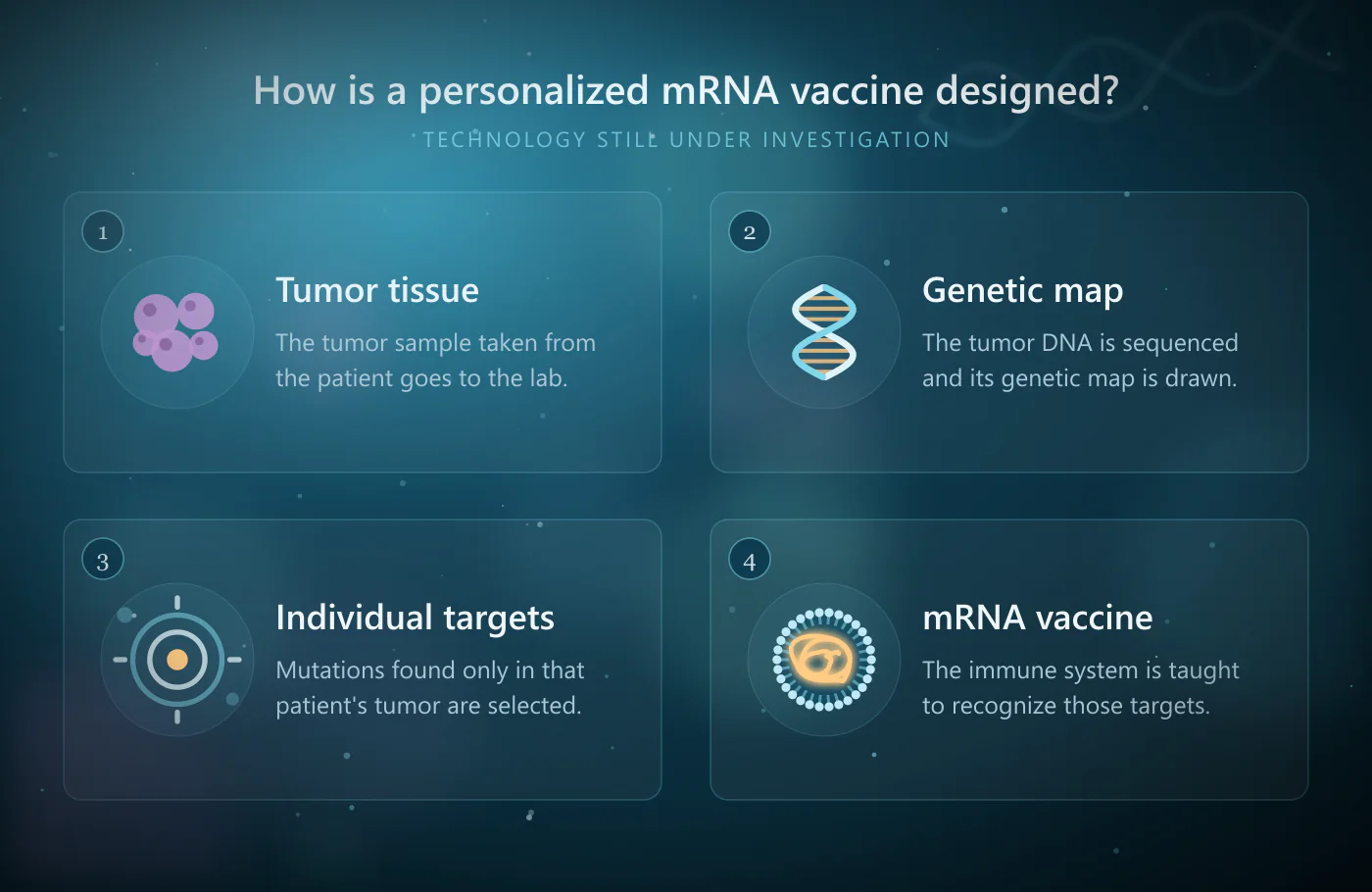
The critical point is this: the content of the vaccine is not written in the laboratory but in the DNA of the patient's own tumor. If the tumor's genetic code cannot be read correctly, there is no target left for such a vaccine to show the immune system.
Where Do the Clinical Trials Stand?
This technology is being evaluated together with an immunotherapy (a checkpoint inhibitor) in melanoma patients whose tumors have been surgically removed but who carry a high risk of recurrence. After promising early-phase results, the research moved into larger advanced-phase trials, and research programs have also been launched in several cancer types beyond melanoma.
Even so, there is no reason to rush. Between a treatment showing promise in early-phase studies and entering routine clinical use lie years of confirmation in large patient populations. That is why we tell our patients and their families very clearly: this vaccine is not an available treatment option today. What is available today is the genetic analysis that forms the very basis of the same scientific logic.
Comprehensive Genomic Profiling: The First and Most Critical Step of Treatment
Both these next-generation vaccines under development and modern oncological approaches show that the first step of personalized cancer treatment is Comprehensive Genomic Profiling (CGP), that is, decoding the genetic signature of the tumor.

Unlike limited tests that look at a single gene, Comprehensive Genomic Profiling screens hundreds of genes in the tumor at once. It evaluates mutations, gene fusions, copy number changes and markers such as tumor mutational burden that can predict response to immunotherapy, all together. In short, it reveals the biological identity of the tumor.
The investigational vaccine applications described here are not performed at our clinic. However, we have for years applied Comprehensive Genomic Profiling, which is also the fundamental requirement of such treatments, together with the analysis of that data by our expert scientific team, as a routine standard of practice for our patients.
How Do We Put Our Genetic and Oncological Experience Into Practice?
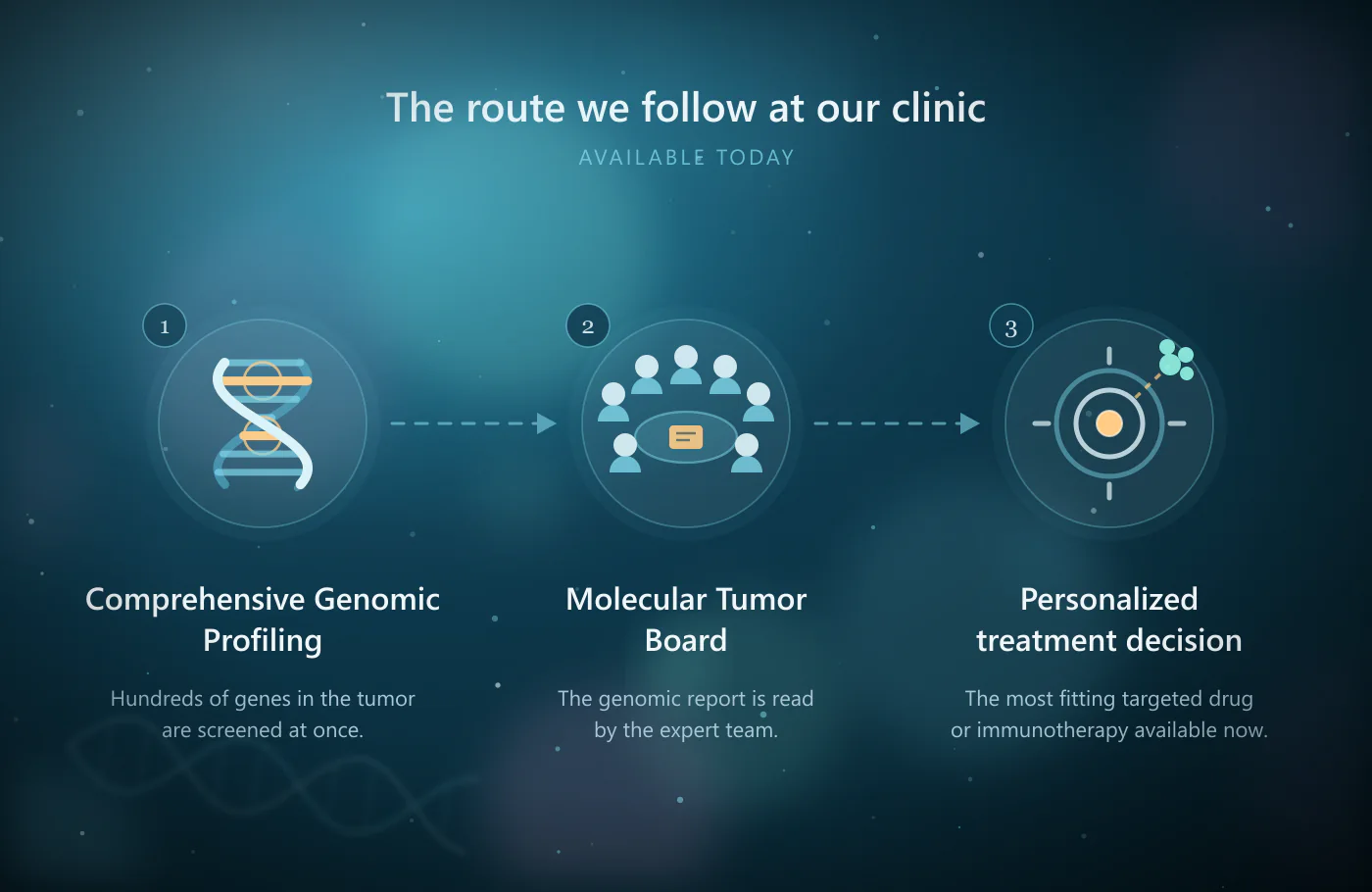
- We map the genetic mutations of the tumor with Comprehensive Genomic Profiling tests performed to international standards.
- We interpret the resulting genetic data in detail with our experienced Molecular Tumor Board (MTB).
- Our aim is to identify the genetic vulnerabilities of the tumor and to match our patient with the most appropriate "targeted smart drugs" or "immunotherapies" that are in use and accessible today.
Receiving a test report is not enough on its own. A genomic report running to dozens of pages must be interpreted together with the patient's clinical picture, previous treatments and the current scientific literature. The structure that performs this interpretation is the Molecular Tumor Board.
Conclusion
In summary, scientific research such as the mRNA cancer vaccine confirms that the future of oncology rests on genetics-driven work. At our clinic we follow this scientific transformation in cancer treatment closely, and with our experience in genetic profiling we continue to build the most accurate, personalized treatment strategies for our patients in the light of scientific evidence.
To evaluate treatment options specific to your tumor biology and to learn more about the Comprehensive Genomic Profiling process, you can get in touch with our clinic.
Sources and Further Reading
- Individualized neoantigen therapy in melanoma (KEYNOTE-942): Weber, J. S., et al. (2024). Individualised neoantigen therapy mRNA-4157 (V940) plus pembrolizumab versus pembrolizumab monotherapy in resected melanoma: a randomised, phase 2b study. The Lancet, 403(10427), 632-644.
- Personalized RNA neoantigen vaccines in pancreatic cancer: Rojas, L. A., et al. (2023). Personalized RNA neoantigen vaccines stimulate T cells in pancreatic cancer. Nature, 618, 144-150.
- Personalized vaccines for cancer immunotherapy: Sahin, U., & Türeci, Ö. (2018). Personalized vaccines for cancer immunotherapy. Science, 359(6382), 1355-1360.
- Comprehensive genomic profiling and molecular tumor boards: Mateo, J., et al. (2018). A framework to rank genomic alterations as targets for cancer precision medicine: the ESMO Scale for Clinical Actionability of molecular Targets (ESCAT). Annals of Oncology, 29(9), 1895-1902.