Overcoming Smart Drug Resistance: Near-Complete Response with a Neratinib-Based Combination After T-DXd

In an HR+/HER2+ metastatic breast cancer patient who developed resistance to T-DXd, the tumor's genetic map was redrawn. After the HER2 pathway was shown to remain active at the RNA level, a combination of neratinib, fulvestrant and paclitaxel produced a near-complete response in the liver metastases.
January 21, 2025 — Our case report, carried out by our team and offering a new approach to the treatment of HR+/HER2+ metastatic breast cancer, was published in Frontiers in Oncology.
In breast cancer treatment, smart drugs, and in particular trastuzumab deruxtecan (T-DXd for short), have been revolutionary in recent years and have brought hope to many patients. But cancer is a clever disease: in some patients the tumor develops resistance to these powerful drugs over time. Once that resistance appears, the standard treatment options available to patients become quite limited.
Our study is highly significant as a report in the literature to break this difficult resistance with a new patient-specific treatment combination (neratinib, fulvestrant and paclitaxel), halting the disease and eliminating the tumors almost entirely.
Study Summary
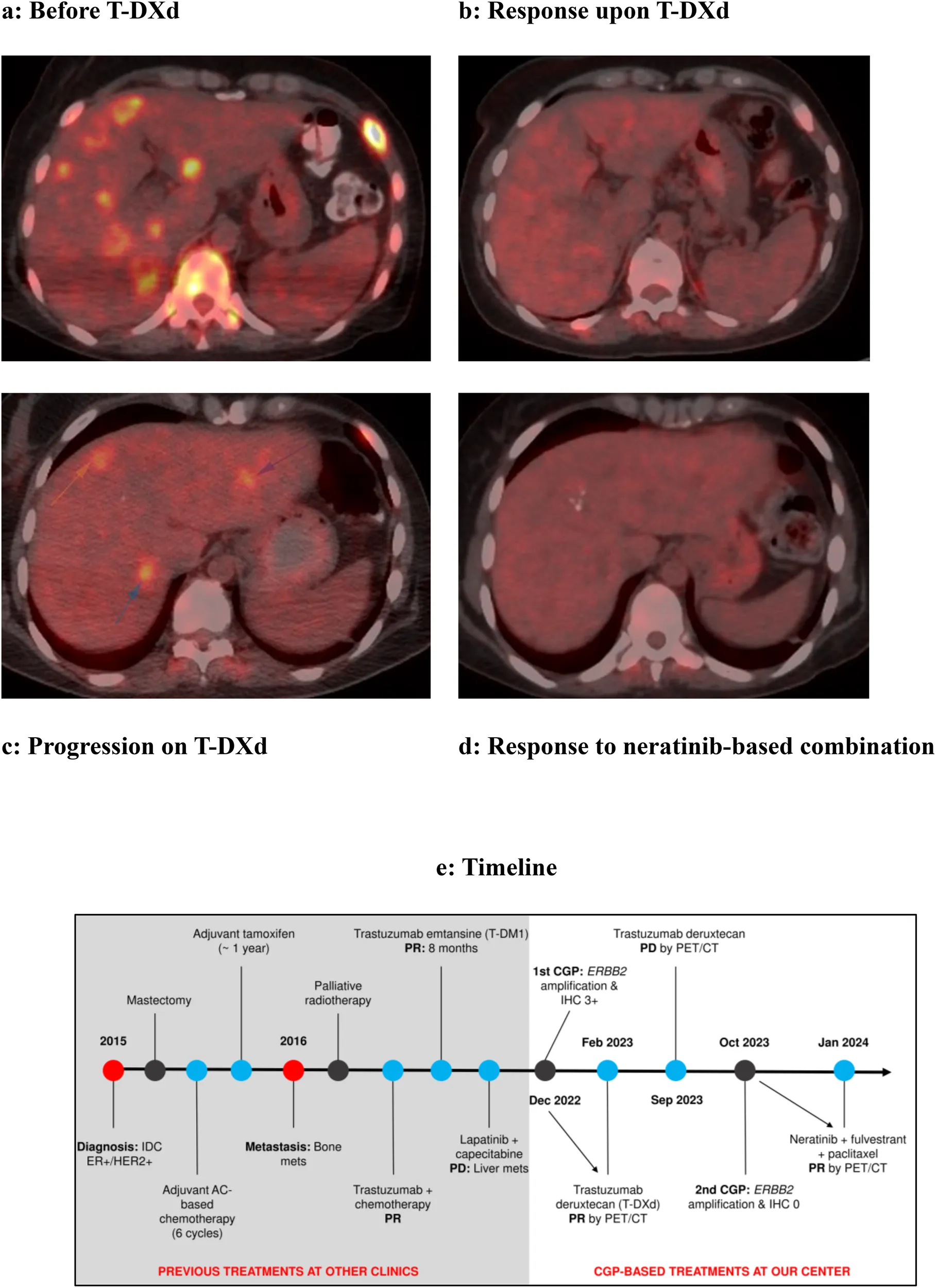
Our article describes the treatment course of a 38-year-old female patient with hormone receptor and HER2 positive (HR+/HER2+) metastatic breast cancer that had spread to the liver. Our patient initially derived excellent benefit from T-DXd, a powerful next-generation smart drug, but after roughly 9 months the tumor developed resistance to it and began growing again in the liver.
At this point our Molecular Tumor Board redrew the genetic map of the tumor through comprehensive genomic profiling. The analyses explored in depth how the tumor had changed: although the HER2 protein on the cell surface had disappeared on histopathological testing, at the genetic level (RNA level) the tumor was found to still be using this pathway to grow. New genetic mutations that the tumor could use to develop drug resistance were also identified.
Based on this new genetic profile, our patient received a triple combination treatment (neratinib, fulvestrant and paclitaxel) targeting the weak points of the tumor. As a result, the liver metastases almost completely disappeared within a very short time, a near-complete response, and this response was maintained over a long period.
Key Takeaways
- Tumors change, and treatments must change too: Cancer is a dynamic, not a static, disease. When a drug stops working, re-examining the genetics of the tumor is vitally important.
- The era of one treatment for everyone is closing: Where standard treatment guidelines reach a dead end, multidisciplinary and molecular tumor boards can produce patient-specific solutions.
- A new combination opens a door: The triple treatment combination used in this case has the potential to open the way to new and larger clinical trials for other patients who develop similar smart drug resistance.
Publication Link: https://www.frontiersin.org/journals/oncology/articles/10.3389/fonc.2024.1484750/full
Images from the Publication