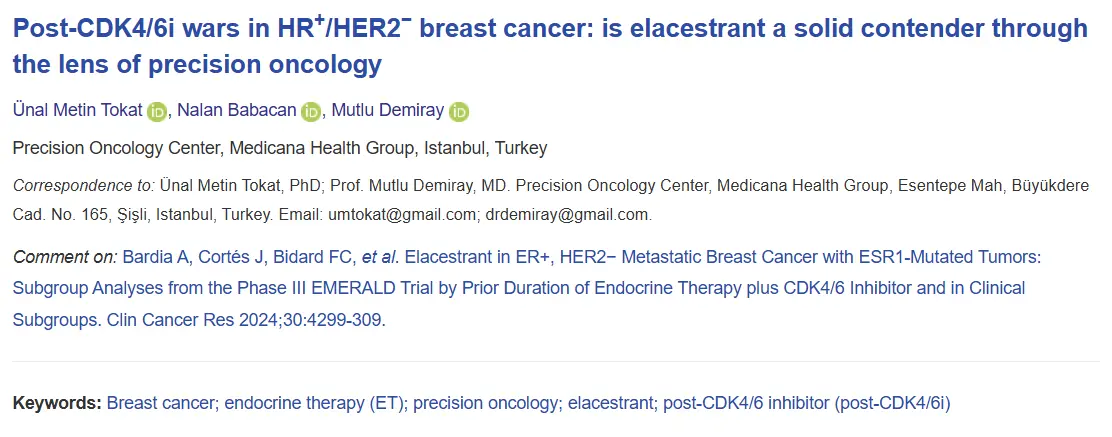
Elacestrant in the Post-CDK4/6 Inhibitor Setting: A Precision Oncology View of HR+/HER2- Breast Cancer

Our editorial on how to choose treatment once resistance to CDK4/6 inhibitors has developed examines the place of elacestrant in the light of the EMERALD subgroup analyses, and argues that the decision should be personalized according to mutations such as ESR1 and PIK3CA.
July 1, 2025 — Our new editorial, written by our team and shedding light on the most current debates in the treatment of advanced breast cancer, was published in "AME Clinical Trials Review".
Why This Study Matters
The standard treatment of hormone receptor positive, HER2 negative (HR+/HER2-) advanced breast cancer is endocrine therapy combined with the smart drugs known as "CDK4/6 inhibitors" (palbociclib, ribociclib, abemaciclib), which stop cell division. In a large proportion of patients, however, resistance to this treatment develops over time.
Which drug to use, and in what order, after resistance has developed (the post-CDK4/6i setting) is currently one of the most debated questions in oncology. Mutations arising in the tumor's genome, such as those in ESR1 and PIK3CA, make this decision even more complex. Our article is important because it analyzes in depth, within the framework of precision oncology, where elacestrant, a recently approved next-generation endocrine drug, belongs in this complex treatment algorithm.
Study Summary
In our article we reviewed the results and subgroup analyses of EMERALD, the large clinical trial that led to the approval of elacestrant. We highlighted that elacestrant is considerably more effective in patients who had benefited from prior CDK4/6 inhibitor therapy for a long time (more than 12 months) and whose tumors had developed an ESR1 mutation.
Alongside the use of elacestrant on its own, we compiled the new clinical trial data showing that combining it with other smart drugs (for example abemaciclib or alpelisib) may be far more successful at overcoming resistance and keeping the disease under control.
We discussed how not only the presence of an ESR1 mutation but also other genetic mutations such as those in PIK3CA or TP53 affect the success of treatment. In patients with a PIK3CA mutation, for instance, we drew attention to the need to add another drug targeting that mutation alongside elacestrant.
Our team also has a case report on this subject: A First in Co-Mutated ESR1 and PIK3CA Disease: The Elacestrant and Alpelisib Combination.
Key Takeaways
- Genomic testing after resistance is essential: The tumor genetics of every patient who develops resistance to CDK4/6 inhibitors must be examined (by liquid or tissue biopsy). The treatment decision should be made specifically according to the mutations that patient carries.
- Trials should be designed around the genomic profile: Future clinical trials should stratify patients into subgroups not only by their general characteristics but by the genomic profiles of their tumors. This will make it far clearer which drug benefits exactly which patient.
- Combinations will be the future standard: Combining next-generation drugs such as elacestrant with other targeted agents (CDK4/6, PI3K, AKT, mTOR and HER2 inhibitors) will define the future standards in the treatment of advanced breast cancer.
Publication Link: https://actr.amegroups.org/article/view/11071/html
Images from the Publication