
Your Clinical Journey in Personalized Oncology: Examination, the Molecular Tumor Board and Our Treatment Process
Cancer treatment is too individual and too dynamic a process to be fitted into standard templates. The personalized oncology approach we practice at our clinic aims not only to prescribe the right drug, but also to unravel the biology of the tumor with great care and to keep our patients transparently informed at every stage of the process. In this article we explain, step by step, how the stages that form the building blocks of your treatment work: the appointment, choosing the right test, the molecular review and the clinical decision.
1. Preparing for Your Appointment, the First Examination and Choosing the Right Test
When you come to our clinic, it is critically important to bring with you the discharge summaries for all the treatments you have received so far, together with your radiological imaging and laboratory results, above all your PET and pathology reports, so that we can analyze the history of your disease completely. If you already have a recent genetic mapping, that is, a Comprehensive Genomic Profiling (CGP) test, you should be sure to add that report to your file. If you do not have a recent CGP report, however, our process continues as follows:
First Consultation and Test Planning: In the first part of your appointment, you have a detailed examination with Prof. Dr. Mutlu Demiray. The clinical course of your disease, your physical condition and your medical data are reviewed. If a new genetic mapping is needed, the test strategy best suited to the current clinical picture is chosen. We use many different tissue and liquid biopsy CGP tests in our clinical practice, and each of these tests has its own technical strengths. Drawing on our deep clinical experience, Prof. Dr. Mutlu Demiray explains to you in detail which test will provide the greatest benefit in your case and guides you through the necessary steps.
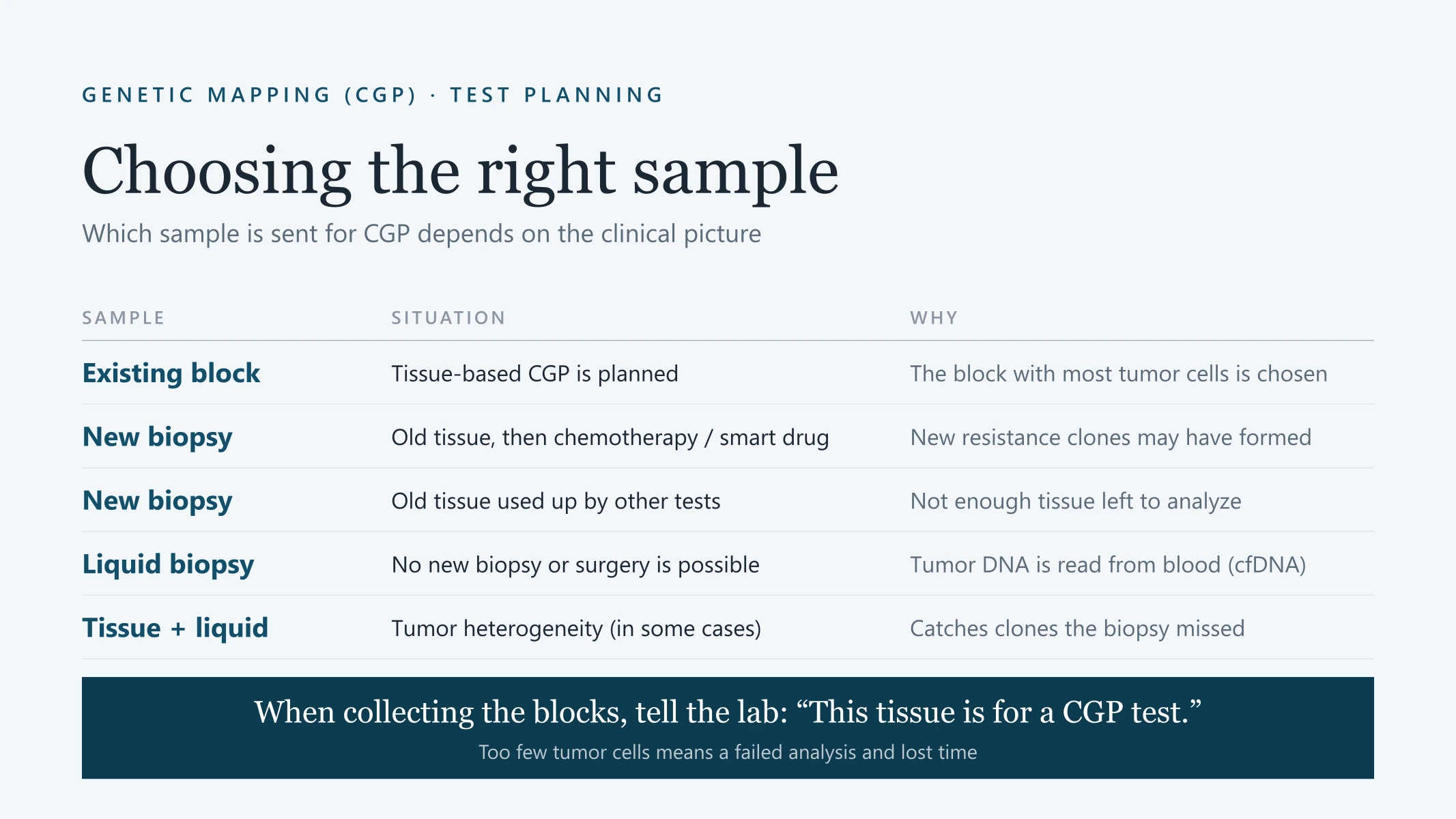
Obtaining the Pathology Blocks: If CGP is to be performed on tissue, the tumor blocks taken earlier by biopsy or surgery must be obtained from the pathology laboratory concerned and brought to our clinic. Under hospital rules, laboratories release this tissue only to the patients themselves or to a first-degree relative. When collecting the blocks, you must tell the laboratory staff that the tissue will be used for a CGP test (genetic mapping). This ensures that the laboratory selects the blocks containing the most tumor cells. This detail is extremely important: if a block without enough tumor cells is sent for testing, the analysis fails, a new block has to be requested from the patient, and vital time is lost.
The Need for a New Biopsy and Resistance Clones: If the patient's surgery or biopsy was performed a long time ago and the patient has since received chemotherapy or smart drug treatment, our clinic always recommends taking a new biopsy. Under the pressure of the treatments received, cancer cells can evolve and develop new resistance clones, and a recent sample of tumor tissue is needed to detect these new clones. A new biopsy is also essential if the old tumor tissue has already been used up for other tests.
Liquid Biopsy and Tumor Heterogeneity: If there is no chance of obtaining new tissue from the patient by biopsy or surgery, a liquid biopsy performed on blood is recommended. In some cases, having a tissue biopsy and a liquid biopsy at the same time provides far more critical information for the patient. The main reason for this is tumor heterogeneity: not every region of a tumor necessarily has the same genetic makeup. A different clone that was not detected in the biopsied region, but is hiding in another corner of the tumor and could affect the course of the disease, can be caught by liquid biopsy thanks to the tumor DNA shed into the blood (cfDNA).
2. In-Depth Analysis of the Report and Molecular Detective Work
Once the test results are available, all of your CGP results, old and new, undergo a preliminary review by our Molecular Tumor Board (MTB).
When your CGP result arrives and you look at the front page of the report, you may see specific targeted drugs suggested directly against some of the mutations. In the reports of some of our patients, however, there may be no approved drug that matches the detected genetic mutations directly. At first glance, this can look very disheartening for the patient. But the core approach of personalized oncology is not simply to prescribe the drugs automatically listed on the first page of a CGP report. The real expertise lies in analyzing the detected mutations in depth, working out the relationships between them and understanding which pathway the tumor is actively using to grow.
To date, the CGP reports of more than 2,500 patients have been reviewed at our clinic. The specialist cancer geneticists on our board examine the mutations detected in your report one by one and research how they are reflected in the current clinical data of the world's scientific literature and in genomic databases. We have many patients whose reports showed no direct drug match, yet in whom the in-depth biological pathway analyses of our Molecular Tumor Board identified the driver mutation behind the tumor's growth, allowing us to intervene successfully. Many of the successful outcomes from these difficult cases have been published in peer-reviewed scientific journals. If you would like to read these inspiring case reports, you can visit the "Our Scientific Publications" section of our website.
3. The Full Board Discussion and the Final Decision
At our clinic, every patient is discussed at the board at least twice.
Once the preparations and the literature review are complete, the cancer geneticist presents your genomic results and the file they have prepared to the entire Molecular Tumor Board. The board then opens the case for a second discussion, from a much deeper perspective, in the light of these new genomic findings.
In the light of all these multidisciplinary assessments, the current scientific publications and international guidelines, Prof. Dr. Mutlu Demiray decides on the most suitable drug or drugs to act on the specific pathways that drive the tumor's growth.
4. The Written Curation Report and Transparent Communication
Once the decision is final, you are invited back to the clinic. At this stage, the personalized treatment plan prepared by the Molecular Tumor Board (the curation report) is always presented to you IN WRITING. Prof. Dr. Mutlu Demiray explains in detail the scientific discussion held at the board, why and how the selected drugs will be used and how they will act on your tumor at the cellular level, answers all your questions and plans your treatment.
If at any point in your treatment you consult a different clinic and are offered a targeted drug based on the CGP test you already have, always ask for the scientific basis of that decision, the literature research behind it and the physician's reasoning IN WRITING. Seeing and examining the scientific grounds of the treatment to be given, in writing, is your most natural right.
5. Dynamic Monitoring: PET, MRD and a Strategy Against Resistant Clones
Once your treatment begins, the results are followed very closely. A new PET/CT assessment after targeted therapy measures the clinical success of the board's decision and, if necessary, the treatment is changed after the board discusses and reviews the case again. We also actively use blood-based minimal residual disease (MRD) tests to track the success of treatment at the molecular level, well before it becomes visible on imaging.
Cancer cells can make remarkably clever maneuvers and, over time, develop new genetic escape routes against the drugs being used. If the disease progresses during treatment (progression), a recent CGP performed without delay identifies the new resistant clones that the tumor has developed in order to survive. Our Tumor Board immediately reopens the case and sets the strategy for targeting these resistant clones with new drugs. In a disease as challenging and changeable as cancer, our aim is to do everything in our power, with our strong world-class scientific infrastructure, our innovative strategies and our experienced multidisciplinary team, to design the most accurate and effective up-to-date treatment for our patients.
Important Information: Although many of the new generation targeted smart drugs and immunotherapies identified through molecular genetic testing have been approved by the U.S. Food and Drug Administration (FDA) and included in international guidelines, their official licensing status and reimbursement by the Social Security Institution (SGK) in Türkiye may vary depending on the active substance. Our clinic shares the legal conditions for obtaining innovative treatments and the aspects of their clinical accessibility transparently with our patients.
To learn more about personalized treatment planning, choosing the right test and the appointment process, you can contact our clinic.