
A New Era in Cancer Treatment: From Conventional Clinical Trial Designs to N-of-One (Personalized) Strategies

In cancer treatment, every tumor carries its own genomic uniqueness, regardless of the stage of the disease. This uniqueness makes it considerably harder to interpret the results of conventional clinical trials, which lump patients with entirely different genetic backgrounds into a single comparison. The SHIVA02 study published in Cancer Research Communications introduced a new way of evaluating scientific research in oncology in order to overcome this difficulty, comparing each patient's treatment outcome not with other patients but with that patient's own previous treatment result (intra-patient control). In this article we explain what the N-of-One approach means, where every patient is regarded as a single and unique study population, what the PFS Ratio measures, what SHIVA02 showed in terms of survival, and why the timing of genomic testing is as critical as the treatment itself.
1. The N-of-One Approach and the Limits of Conventional Clinical Trials
Metastatic cancers have an extremely complex structure and, much like "malignant snowflakes", each one differs completely from the next in every patient. This is why conventional clinical trials focused on an organ of origin, or on a single mutation alone, fall short.
- Horizontal heterogeneity: Even when cancers arise from the same organ, they may be driven by entirely different genetic drivers; "lung cancer" is not a single disease.
- Vertical heterogeneity: Over time, and under the pressure of the treatments given, a tumor evolves by acquiring new genetic changes; the target that is valid today may give way to a resistance mechanism tomorrow.
- According to a recent article published in Trends in Cancer, this high level of complexity makes it essential to treat patients in oncology with N-of-One strategies and personalized drug combinations.
- In this new era, alongside innovative designs such as SHIVA02 that take the patient's own treatment history as the reference, Real World Data (RWD) and Master Observational Trials (MOT) built on vast registries also play a critical role in evaluating treatments.
2. Taking the Patient's Own Treatment History as the Reference: the PFS Ratio
Designed around the philosophy of N-of-One, SHIVA02 was a tissue agnostic basket trial, independent of where the tumor is located, built on the investigation of patients refractory to standard treatments through Comprehensive Genomic Profiling (CGP).
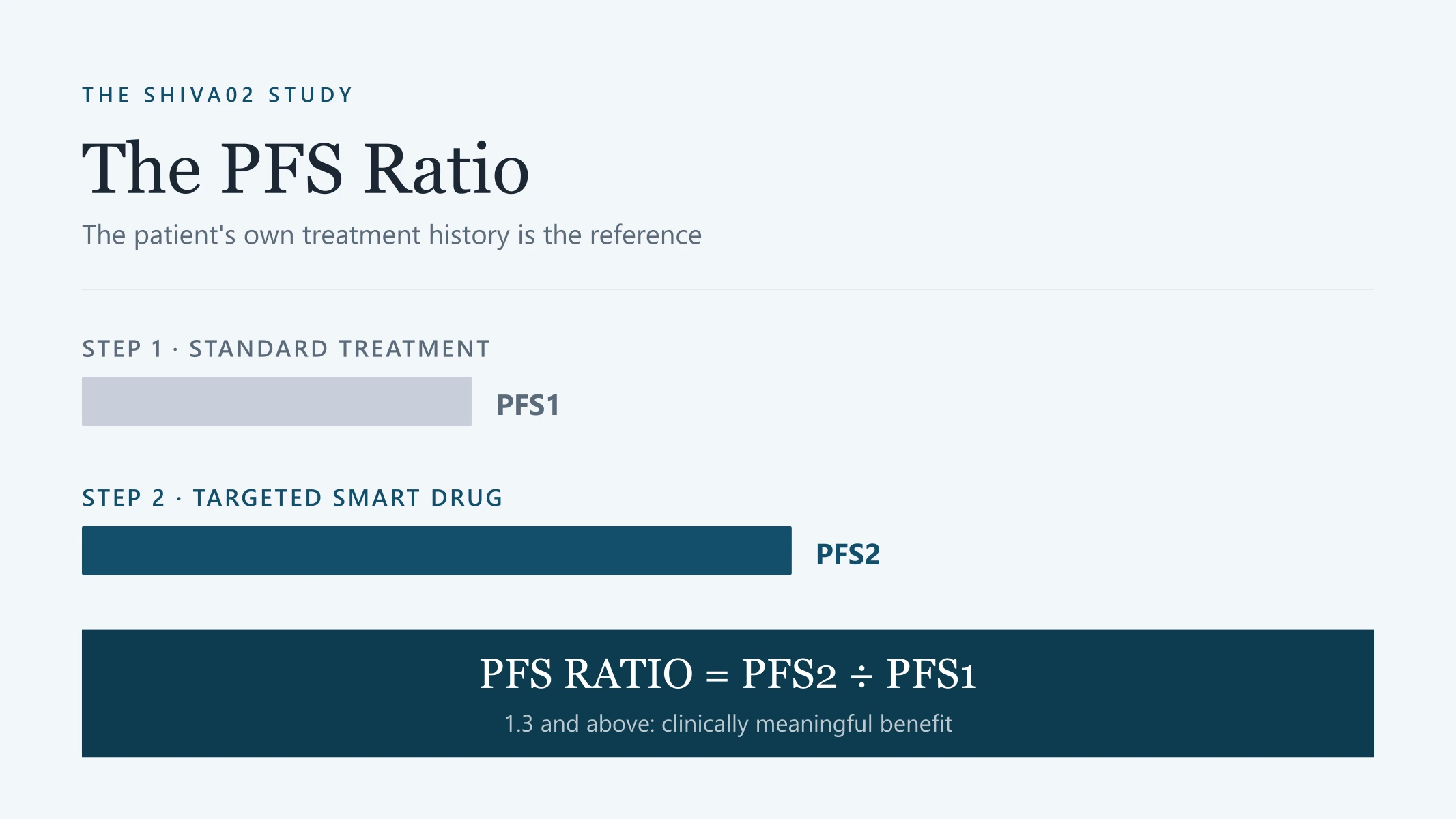
- Patients first received a standard treatment (Step 1), and progression free survival during this period, that is the time the disease went without progressing, was measured as PFS1.
- When the disease progressed, patients moved on to genetically targeted smart drugs approved by the Molecular Biology Board (MBB) (Step 2), and the duration of disease control in this step was calculated as PFS2.
- The success of treatment was evaluated through the PFS Ratio (PFS2 / PFS1), obtained by dividing the time gained with targeted therapy by the time gained with standard therapy.
- A ratio clearly above 1 means the patient achieved a genuine gain compared with their own history. The comparison is therefore made with the patient themselves, not with a genetically entirely different group of patients.
3. The Striking Results of the Study and the Survival Advantage
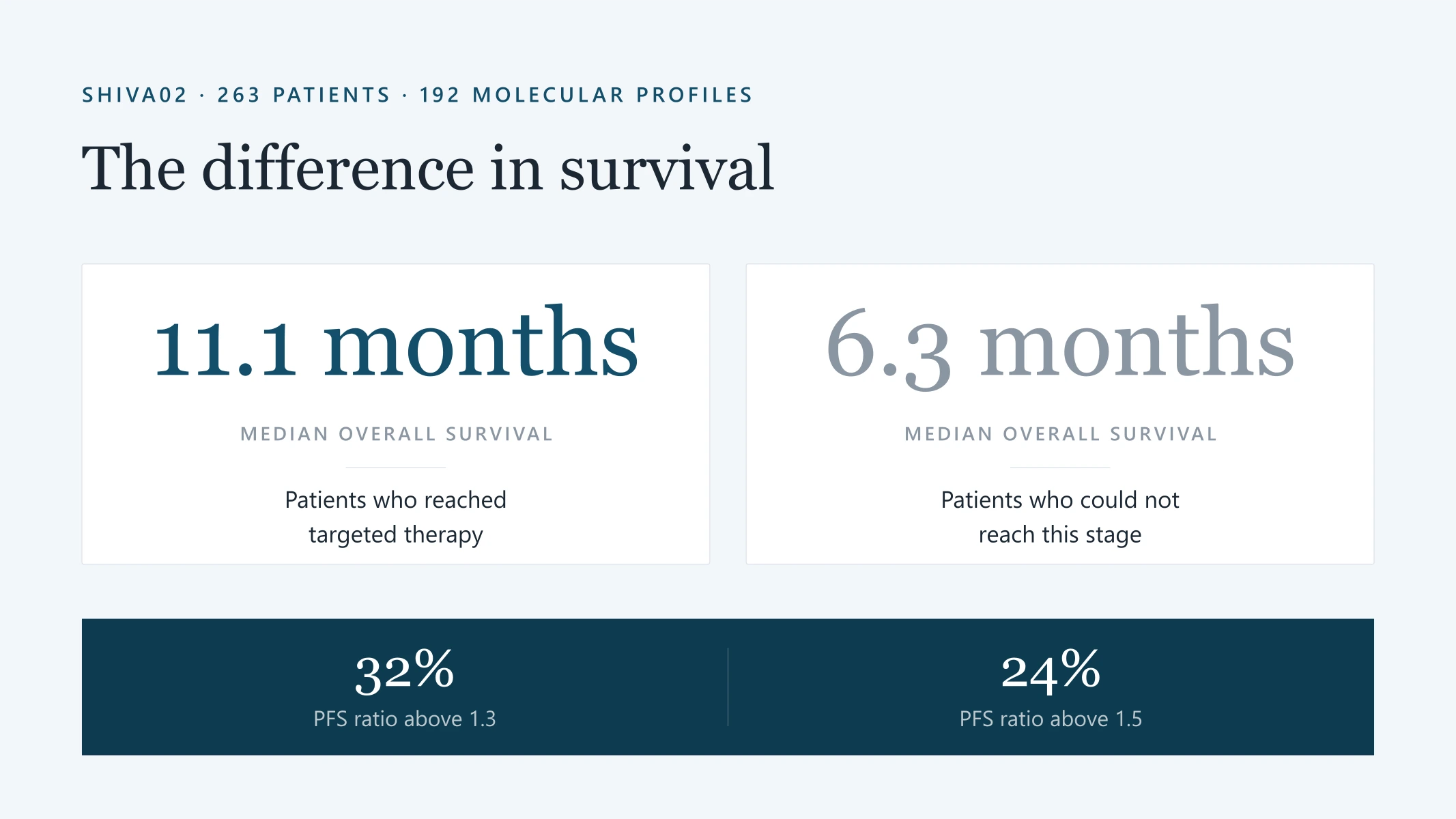
In this study, which enrolled 263 patients across different cancer types and successfully produced a molecular profile for 192 patients, the data demonstrated the power of the molecular approach.
- Among patients who reached the second stage and were able to receive targeted therapy, the PFS ratio exceeded 1.3 in 32% and 1.5 in 24%, providing a clinically meaningful benefit.
- In the group that was able to move on to targeted therapy based on the molecular profile, median overall survival was 11.1 months.
- In patients who could not reach this stage because of disease progression or deterioration in their clinical condition, median overall survival remained at 6.3 months.
4. The Most Important Lesson for Our Clinical Practice: the Right Treatment at the Right Time
One of the most critical messages SHIVA02 delivered to the world of oncology concerns the timing of genetic testing.
In the study, a substantial proportion of the patients who were successfully tested (roughly 50%) lost the opportunity to receive the targeted treatments of the second stage, because their clinical condition (ECOG performance status) deteriorated during the standard treatment of the first stage.
This finding shows clearly that performing genomic profiling only once every standard treatment option has been exhausted creates a major disadvantage for patients.
Even when the right target is in your hands, the information becomes unusable in practice once the patient's performance status has declined to the point where they can no longer tolerate that treatment.
The core philosophy we follow at our clinic is to give the patient the most appropriate treatment from the very first moment. Guided by the data we obtain with comprehensive panels such as Whole Exome (WES) and Whole Transcriptome (WTS) sequencing, and in the light of scientific evidence and guideline knowledge, we are able to start our patients directly on targeted smart drugs.
If progression or resistance develops during treatment, instead of remaining tied to the current regimen or to a test performed months ago, we carry out a new CGP or a liquid biopsy from blood to detect the new resistance genes the tumor has developed over time (vertical heterogeneity), and we reshape the treatment according to this up to date genomic data.
5. The Decision Making Power of the Molecular Tumor Board (MTB)
Both in the SHIVA02 study and in modern N-of-One strategies, the single most decisive element of success is that treatment decisions are made by a multidisciplinary board of oncologists, pathologists and geneticists.
In our clinical practice, our Molecular Tumor Board (MTB), made up of 6 specialist cancer geneticists and experienced oncologists, manages this process. Monotherapies that target a single genetic pathway are often insufficient to overcome the complex escape routes and resistance mechanisms of cancer cells. For this reason our board examines the genomic and transcriptomic data in depth and designs rational combination therapies that strike several of the tumor's weak points at once and break cellular resistance.
Our aim is to produce the safest and most effective solutions suited to the unique biology of each of our patients, using the most current genetic data science has to offer.
To learn more about comprehensive genomic profiling and personalized treatment planning, you can contact our clinic.
Sources and Further Reading
- SHIVA02 Study: du Rusquec, P., Dupain, C., Geiss, R., Sablin, M.-P., Castel-Ajgal, Z., Cassier, P., ... & Le Tourneau, C. (2026). SHIVA02 trial: Using patients as their own controls to assess efficacy of therapies based on molecular profiling in patients with refractory cancer. Cancer Research Communications.
- The N-of-One Paradigm: Adashek, J. J., Subbiah, V., & Kurzrock, R. (2021). From Tissue-Agnostic to N-of-One Therapies: (R)Evolution of the Precision Paradigm. Trends in Cancer, 7(1), 15-28.